Writer/Director Jasmin Mozaffari
Stars: Behtash Fazlali, Oriana Leman, Brigitte Solem, John Ralston, Nima Gholamipour
Niaz Salimi, Daniel Henkel
Based on a true story Set in 1979 at the height of the Iran Hostage Crisis. ‘Motherland’ follows Babak, a young Iranian immigrant questioning his future prospects in America after he visits his fiancé’s parents.
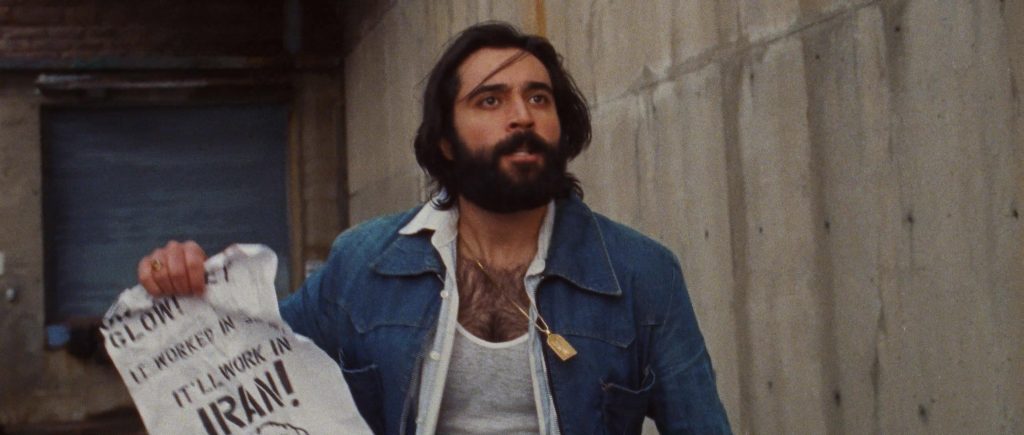
Writer/director Jasmin Mozaffari delivers a harrowing, semi-autobiographical look at the Iranian immigrant experience in post-Vietnam America. As the Iran Hostage Crisis unfolds, medical student Babak (Behtash Fazlali) navigates daily discrimination while clinging to the hope of his future career and his marriage to Katie (Oriana Leman). His optimism for the future is increasingly strained by the escalating troubles back in his motherland. Babak is left caught between a disappearing past and a hostile present.
The Distance of Diaspora
Diaspora stories are fundamentally shaped by cultural context, identity formation, and the unique challenge of maintaining homeland connections while navigating a new country. Drawing from her own parents’ intercultural marriage, Mozaffari expertly illustrates these realities through the lens of isolation.
Babak already feels like a stranger in his new home due to persistent racist attacks. It is the separation from his family that truly drives his isolation home. The physical distance is underscored by the era’s reliance on costly poor-quality long-distance calls through the first available payphone. We get a stark contrast to the instant connectivity of the modern WhatsApp era.
The emotional distance is most acutely felt through Katie’s father. In a masterfully tense scene, Mozaffari plays with audience anticipation; an initially friendly handshake and shared history suggests a connection, only for the tone to shift into a darker place. Katie’s father (John Ralston) is not a card carrying Klansman, his concern is for his daughter’s well-being. His hostility becomes evident through his own childhood experiences regarding his German roots curdling into a xenophobic prejudice. It’s a bigotry fuelled by the fear-mongering political rhetoric and press of the time.
A No-Win Crossroads
The film draws chilling parallels between two societies that trap Babak in a psychological “no-man’s land.” While his mother pleads with him to stay in the U.S. to avoid a burgeoning war zone, Katie’s father actively prays for his deportation. Mozaffari uses powerful visual contrasts to illustrate this alienation, specifically through the juxtaposition of celebration and protest.
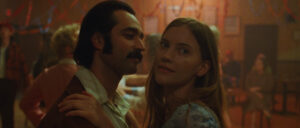
In Katie’s hometown, the community finds unity in line dancing, a world Babak desperately wants to integrate into. Yet he is simultaneously haunted by images of his kin swept up in the chaos of demonstration rallies back home. This sense of total abandonment is further amplified following the chilling confrontation with Katie’s father, where Babak’s desperate run to a payphone to call his family serves as a visceral symbol of his search for a lifeline in a world he feels has turned its back on him.
Identity as a Survival Tactic
While many diaspora films focus on a general “clash of cultures,” Motherland is far more raw, focusing on the deep-seated impact of sociopolitical conflict. We see Babak forced to strip away his Iranian identity—shaving his beard and Americanizing his name—simply to survive.
This erasure is an all-too-familiar real life tactic where “Mohammed” becomes “Mo” or “Rahim” becomes “Ray.” It is a phenomenon mirrored in the work of other Iranian filmmakers, such as Kayvon Derak Shanian’s Living in Fear, where the protagonist Kamran adopts the Western-friendly “Cameron.” In Mozaffari’s hands, these small concessions are revealed for what they truly are: a real life survival tactic that leads to the slow, heartbreaking erosion of a human soul.
Final Thoughts
Nearly 50 years after the events depicted, Motherland serves as a bleak reminder of how little has actually changed. Today, we see blatant racism and rampant xenophobia once again becoming acceptable norms—a chilling echo of the prejudice that followed the 9/11 attacks. It is a heartbreaking, thought-provoking portrait of how identities are belittled and erased under the weight of Islamophobia and racial profiling.
Mozaffari’s film is far more than a period piece; it is a vital entry in the canon of diasporic cinema. Much like Julia Elihu and Ava Lalezarzadeh’s In the Garden of Tulips, it portrays an authentic immigrant experience that few truly understand: the profound sacrifice of leaving one’s home, potentially forever. Where In the Garden of Tulips highlights the acute pain of the initial departure, Motherland picks up the thread, illustrating the haunting uncertainty of life in a “new world” that remains unwelcoming.
Join The Conversation
Have you experienced the power tale of ‘Motherland’? Were you moved by Babak’s plight? Did the film resonate in any way? As immigrants become the bad guys thanks to certain world leaders, is this the immigrant story to change that?
I’d love to read your thoughts! Let me know in the comments below. You can also head over to the Cine Bijou on Bluesky, Threads, and Instagram to share your thoughts with our growing community of cinephiles.